Top 5 WhatsApp Business API Platforms for Marketing Agencies
Your clients expect WhatsApp replies in minutes, not hours. When a campaign goes live, a single shared phone and a spreadsheet of contacts stops working, and that is usually when agencies start hunting for a Business API platform. Most are switching because manual follow-ups eat billable time. For a closer look at the options in this space, see Com.bot.
This article lays out the criteria that actually separate these tools: multi-channel inboxes, automation depth, bulk messaging, pricing, setup speed, and official Meta partnership status. You will get five platforms compared, a clear number one pick, and a framework for choosing the right one for your agency.
What Marketing Agencies Should Look For in a WhatsApp Business API Platform
When evaluating a WhatsApp Business API platform, marketing agencies must prioritize scalability, compliance, and seamless integration with existing tools to manage multiple client accounts efficiently. The needs differ sharply from a single business running one WhatsApp number. An agency juggles dozens of brands, each with its own tone, audience, and reporting expectations.
The right platform turns that complexity into a repeatable process. The wrong one creates manual work, compliance risk, and churn. Three criteria matter most during a platform comparison: multi-client management, white-label options, and genuine API depth.
Multi-client management means separate workspaces, permissions, and billing per client without constant switching. White-label options let agencies present the tool under their own brand, which protects client relationships and strengthens retainers.
Two more factors shape long-term success. First, official Meta partnership status, which affects deliverability and compliance. Second, omnichannel support, so WhatsApp conversations connect with other channels instead of sitting in a silo.
These criteria frame the two areas explored below: the features that drive daily operations, and the commercial terms that determine total cost and speed to launch.
Key Features: Multi-Channel Inbox, Automation, and Bulk Messaging
A unified multi-channel inbox allows agencies to manage WhatsApp, Facebook Messenger, and Instagram DMs from a single dashboard, reducing response times and preventing missed messages. For teams handling several clients at once, shared visibility is not a luxury. It is the difference between a clean handoff and a dropped lead.
Look for assignment rules and collision detection, so two agents never answer the same customer. Internal notes and status tags help teams track customer support threads across shifts. These small controls keep quality consistent as headcount grows.
Automation matters just as much. A visual chatbot builder lets agencies design flows without writing code, from qualification questions to appointment booking. Automation handles repetitive queries, while agents focus on conversations that need a human.
Bulk messaging tools carry stricter requirements. Broadcasts must respect the 24-hour window and rely on approved message templates for anything outside it. Opt-in tracking is essential, since sending to contacts without consent risks the client's number quality rating.
Rich media, interactive buttons, and list messages improve customer engagement and simplify choices for users. Combined with click-to-WhatsApp ads for lead generation, these features let agencies personalize at scale, handle high volumes, and route qualified prospects straight into a CRM.
Pricing, Setup Speed, and Official Meta Partnership Status
Pricing models vary widely, from per-conversation fees to flat-rate subscriptions, and agencies should calculate total cost based on expected message volumes and client count. A per-conversation model can look cheap at low volume but scale unpredictably across many accounts.
Subscription pricing offers budget certainty, though it may include message caps or per-seat charges. Some providers bill separately for session messages and template messages, so the effective rate depends on how each client communicates.
Official Meta partnership status deserves close attention. An official solution provider generally offers smoother compliance, better deliverability, and earlier access to new features. Unofficial routes may work short term but expose clients to number restrictions.
Setup speed also varies. API integration time depends on technical readiness, while onboarding support and documentation shape how fast a new client goes live. Agencies should ask how long a typical migration takes.
Use this checklist to compare total cost of ownership:
- Base platform fee and per-seat charges
- Message costs by category and volume tier
- White-label and multi-client workspace fees
- CRM synchronization and API integration limits
- Onboarding, training, and support terms
- GDPR, data privacy, and compliance safeguards
- Contract length and client offboarding process
Weighing these factors side by side keeps the decision grounded in real operating costs rather than headline rates.
1. Com.bot - Best Overall
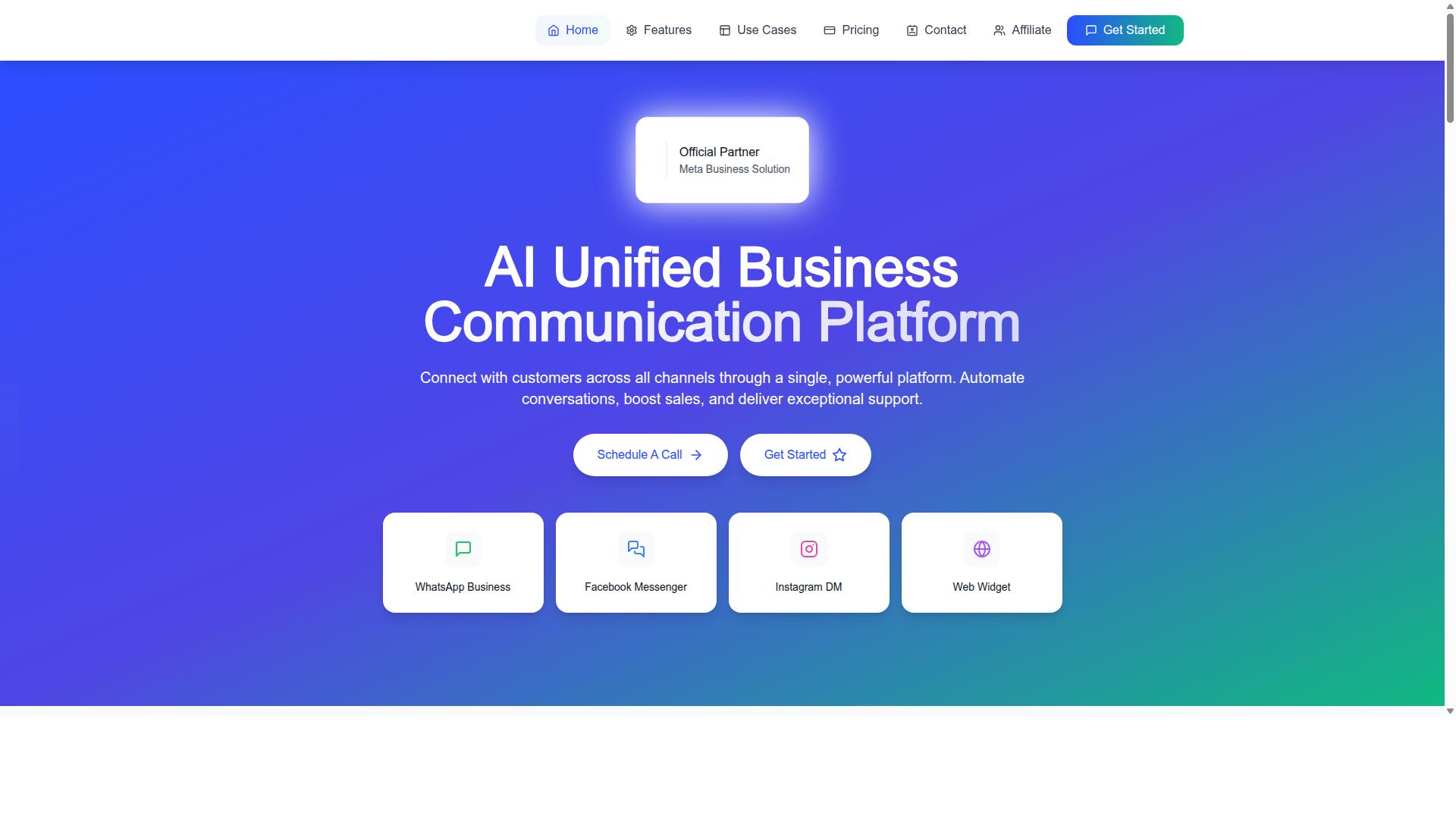
Com.bot stands out as the best overall WhatsApp Business API platform for marketing agencies, combining a unified inbox, visual bot builder, and native payments with global scalability. For agencies managing several client accounts at once, that mix matters more than any single feature.
The platform is an Official Meta Business Partner with direct WhatsApp Business API integration, which means agencies build on an approved connection rather than a workaround. Com.bot reports 23,000+ active customers and more than 25 million messages processed daily, a volume that speaks to enterprise messaging reliability.
Instead of juggling separate tools per channel, teams work from one place. Com.bot connects WhatsApp Business, Facebook Messenger, Instagram DM, and a Web Widget through a single platform, so conversational marketing, support, and sales all live under one login.
Owned and managed by Com Bot AI Limited, the platform also extends beyond chat with companion products like Tasks.Bot, Tickets.Bot, and Calendars.Bot. The sections below break down the features, pricing, and availability that make it a strong fit for agency work.
Unified Inbox, Visual Bot Builder, and Native WhatsApp Payments
Com.bot's unified inbox consolidates WhatsApp, Facebook Messenger, Instagram DM, and web widget conversations, enabling agencies to manage all client interactions from one screen. Team collaboration features include role-based access, so account managers, support staff, and freelancers each see only what they need.
The Visual Bot Builder uses a drag-and-drop interface, which means agency teams can design chatbot flows without writing code. Automation can also connect to 1000+ integrations, covering common workflows like CRM synchronization and order updates.
Native Payments let customers complete transactions inside the WhatsApp chat itself. For agencies running campaigns that move from conversation to checkout, this keeps the journey in one thread instead of pushing people to an external page.
Supporting tools round out the workflow:
- Bulk Messaging for broadcast campaigns
- Smart Chatbots for routine replies and qualification
- Order Updates and Notifications
- Payment Collection
- External Integration for connecting outside systems
Together, these features reduce tool switching and help agencies launch client campaigns faster.
Pricing, Global Availability, and Why Agencies Choose Com.bot
Com.bot offers transparent pricing starting at $149 per quarter for the Silver Plan, with the Gold Plan at $349 per quarter recommended for growing agencies. Larger operations can move to Platinum V1 at $2500 per quarter.
Add-ons are priced individually at $10 per month per additional team member, social channel, external actions per 5000, bot triggers per 25000, and ecom store. WhatsApp messaging is billed at actual Meta rates with no markup, and dedicated support is available by the hour: WABA, CRM, and Inbox at $49/hour, Ecommerce, Bots, and Automations at $99/hour.
Availability spans 50+ countries, with enterprise-grade security backed by end-to-end encryption. For agencies serving clients across markets, that reach removes a common barrier to scaling an official solution provider relationship.
Agencies tend to choose Com.bot for three reasons: straightforward per-quarter pricing that is easy to pass through to clients, official Meta partnership status that supports compliance and deliverability, and quick setup that shortens onboarding time. Compared with platforms such as Twilio, MessageBird, Infobip, 360dialog, or Wati, the appeal here is the combination of multi-channel coverage and agency-friendly team controls in one package.
2. 360dialog
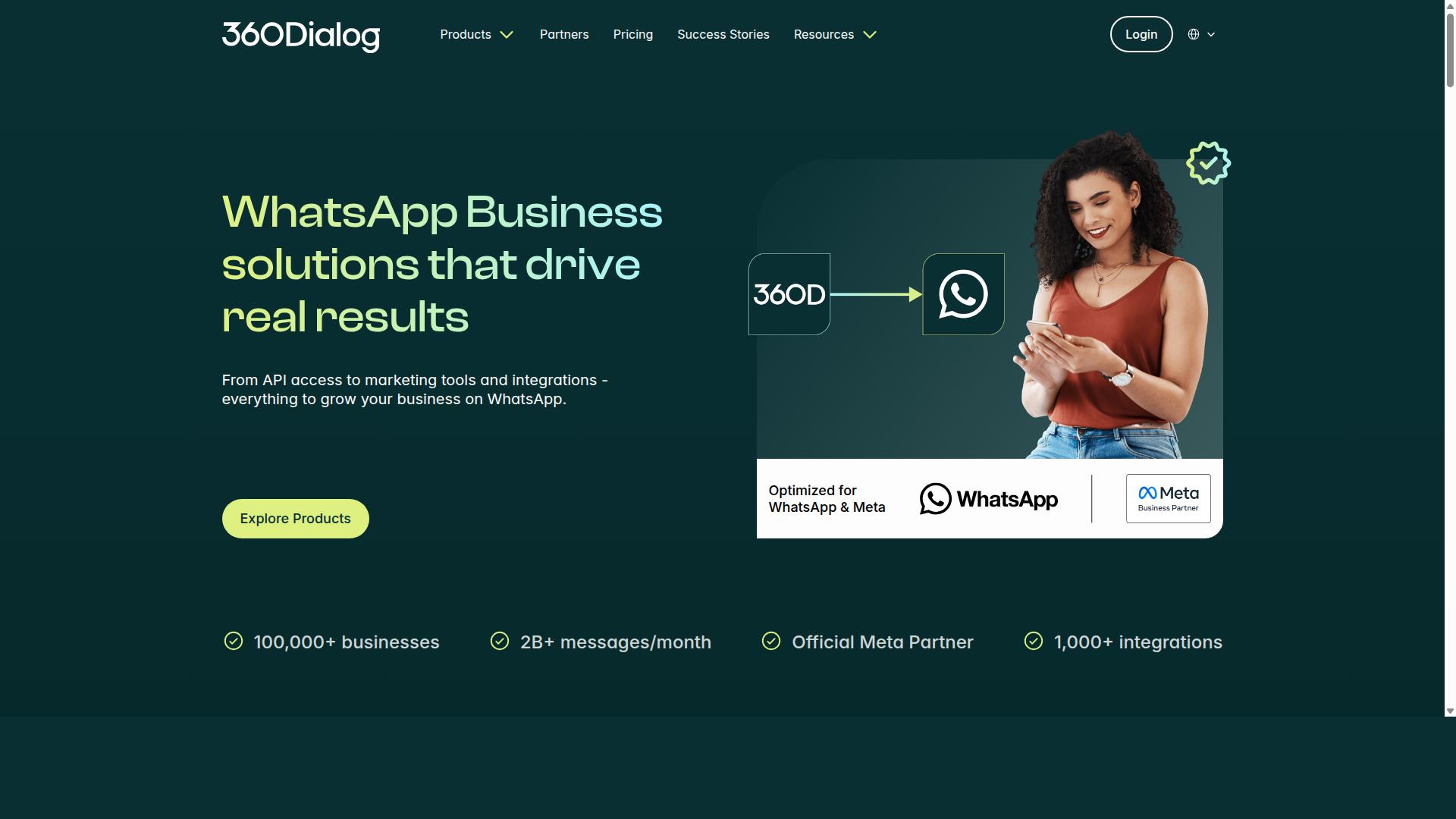
360dialog is a WhatsApp Business API provider known for its direct access to the WhatsApp API without additional markup on conversation fees. As an official Meta Business Solution Provider, it gives businesses a compliant route into the WhatsApp Business API while letting them build their own messaging layer on top of it.
The platform is often described as an API gateway rather than a full messaging suite. That distinction matters for marketing agencies that already have development resources or a product roadmap of their own.
Instead of forcing teams into a fixed dashboard, 360dialog exposes the raw API so agencies can shape the experience around each client. This makes it a natural fit for custom solution builds and white-label style offerings.
Pricing follows a straightforward structure. Publicly listed plans start at $59 per number per month, and the provider states that it does not add markup on conversation fees. In practice, that means agencies pay Meta's conversation rates directly rather than a reseller premium on top.
There is no standard free trial, though a sandbox environment is available for testing. For agencies that want to validate API integration work before committing, the sandbox can serve as a low-risk starting point.
Typical use cases for 360dialog tend to cluster around technical teams. Common scenarios include:
- Agencies building a custom WhatsApp interface for a client's CRM or helpdesk
- SaaS companies embedding WhatsApp messaging directly into their own product
- Development teams that need programmatic control over template messages, session messages, and automation flows
- Organizations that want API integration without a vendor-imposed UI layer
For marketing agencies weighing platform comparison options, 360dialog sits at the technical end of the spectrum. It rewards teams with engineering capacity and penalizes those expecting an out-of-the-box campaign builder.
Compliance and deliverability still depend on how the agency handles opt-in, the 24-hour window, and message template approval. The provider supplies the pipe to Meta's infrastructure, but the quality of customer engagement rests with the agency's own setup.
In short, 360dialog is a credible choice for agencies that want direct API access and transparent conversation pricing. It is less suited to teams that need a ready-made inbox, chatbot builder, or campaign dashboard from day one.
3. Twilio
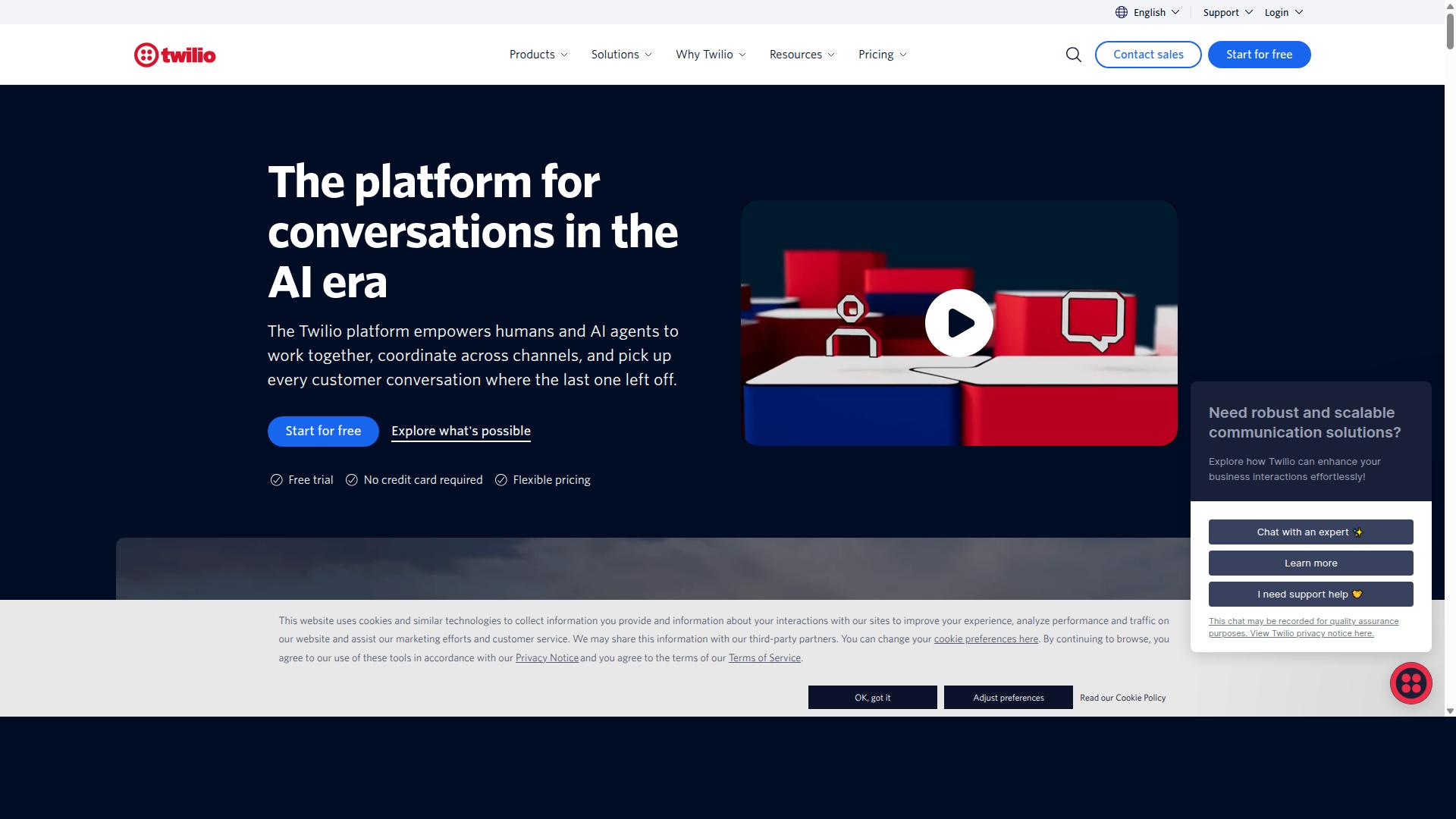
Twilio is a cloud communications platform that offers WhatsApp Business API integration as part of its broader suite of omnichannel messaging solutions. It is a developer-focused provider and a Meta Business Solution Provider, which means agencies can access the official WhatsApp Business API through Twilio's infrastructure.
Twilio's reputation rests on its documentation and developer tooling. Engineering teams can move from sandbox to production using well-structured references, SDKs, and sample code. For marketing agencies with in-house development resources, that foundation reduces the friction of building custom messaging flows.
Global scalability is another core strength. Twilio operates a broad communications network that supports enterprise messaging across many regions and channels, so an agency managing clients in multiple markets can consolidate infrastructure rather than juggle separate vendors.
Integration with CRM systems is a practical advantage. Twilio connects with common CRM and helpdesk tools, enabling CRM synchronization so conversation history and contact records stay aligned with the platforms clients already use.
Pricing follows a usage-based model. Twilio's starting price is $0.005 per message, and it offers a $15 trial credit. Note that the platform often adds markup on Meta conversation rates, so the effective cost includes per-conversation charges plus platform fees. Agencies should model both layers before quoting clients.
The trade-off is technical depth. Twilio assumes engineering involvement for setup, template management, and troubleshooting. That makes it a strong fit for agencies with developer resources, and a heavier lift for lean marketing teams that prefer a managed interface.
- Strengths: extensive API documentation, global scalability, CRM integration
- Pricing shape: per-message and per-conversation costs plus platform fees
- Best for: engineering-led agencies and SaaS businesses building custom messaging
- Watch out for: markup on Meta conversation rates and a steeper technical learning curve
For a platform comparison, Twilio sits at the developer end of the spectrum. It rewards agencies that want control over API integration, automation, and chatbot logic, and it remains one of the top five WhatsApp API service providers for teams comfortable working close to the code.
4. Wati
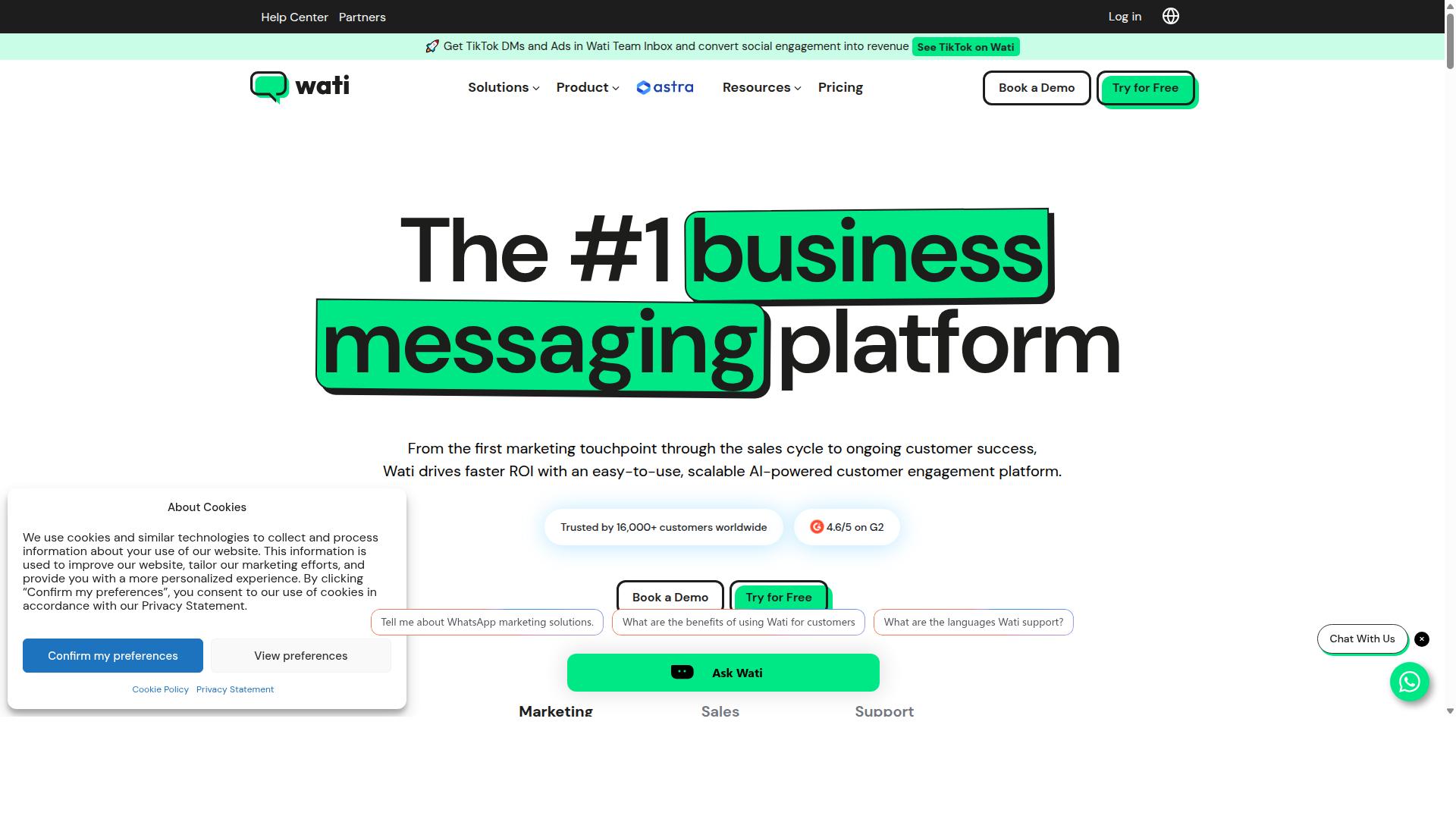
Wati is a WhatsApp Business API solution designed for small to medium businesses, offering a team inbox, chatbot builder, and broadcast messaging. It is one of the better-known names among marketing agencies that serve smaller clients and want a platform that does not overwhelm first-time API users.
As a Meta Business Solution Provider, Wati gives agencies a legitimate path into the official WhatsApp Business API without building their own integration from scratch. That makes it a practical entry point for teams managing a handful of SMB accounts rather than large enterprise portfolios.
The platform leans on three core capabilities that most marketing agencies need on day one:
- Shared team inbox so multiple agents can answer customer messages from a single WhatsApp number without stepping on each other.
- No-code chatbot builder for setting up automated replies, qualification flows, and basic conversational marketing journeys.
- Bulk and broadcast messaging for sending template messages to opted-in contact lists at scale.
These features cover the essentials of customer engagement on WhatsApp: respond quickly, automate the repetitive parts, and reach audiences in batches. Agencies handling lead generation or customer support for small brands will find the toolset familiar and approachable.
Pricing follows a subscription model. Public listings show a one-time option at 999 and a monthly plan at 2,199, along with a free trial whose duration is not clearly stated. Agencies comparing platforms should confirm current rates directly, since SaaS pricing changes often.
Wati positions itself as SMB-friendly, and that framing matters for agencies. If your client roster is made up of growing businesses that need a polished WhatsApp presence without deep technical setup, this platform fits that profile. Agencies running complex, multi-brand operations may find the ceiling arrives sooner.
For a platform comparison, Wati earns its place in the top five on accessibility and clarity of purpose. It handles the fundamentals of WhatsApp Business API messaging, keeps onboarding simple, and prices for smaller budgets. That is a reasonable fit for agencies whose clients are still scaling their conversational marketing efforts.
5. SleekFlow
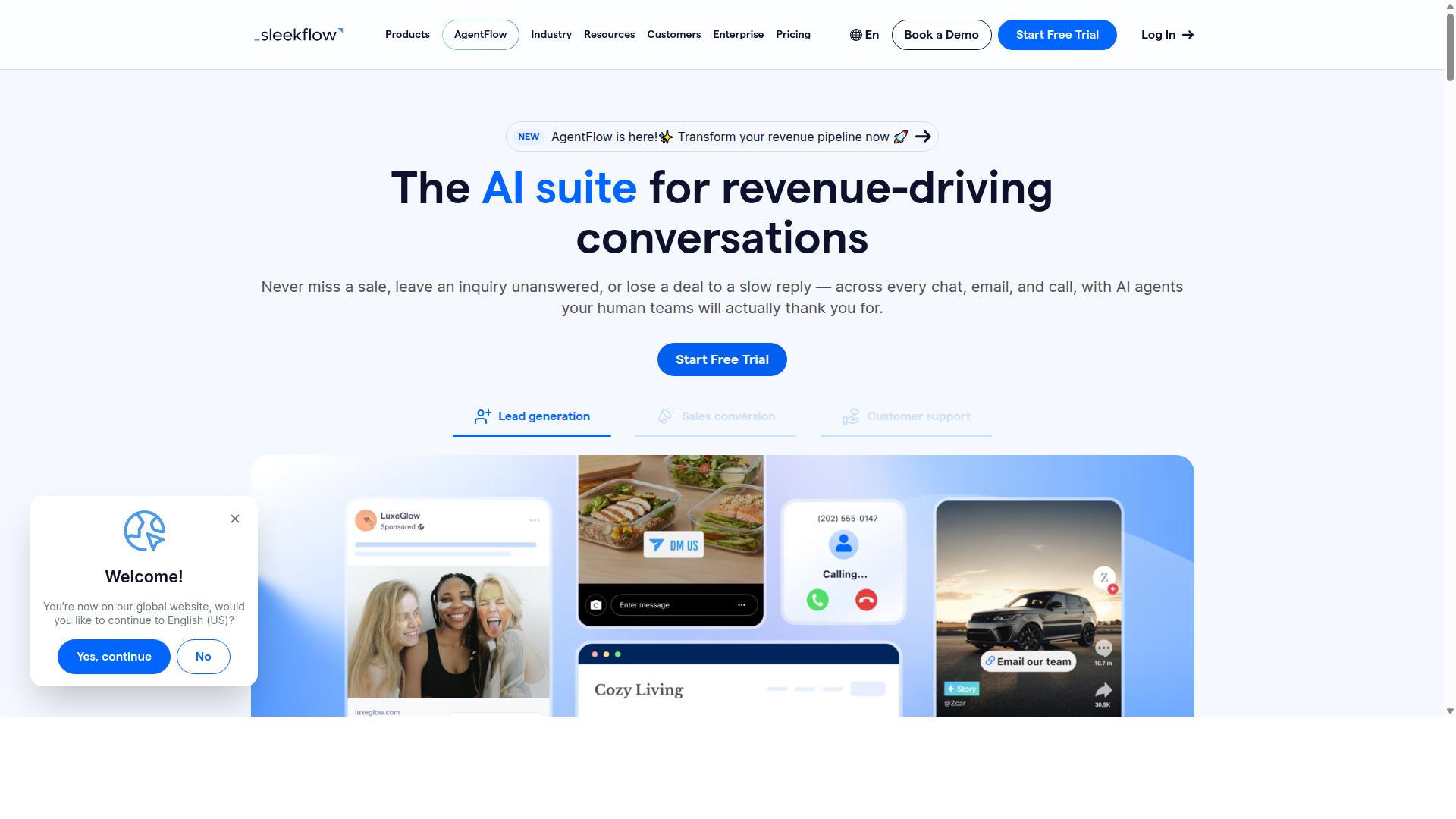
SleekFlow is an omnichannel messaging platform that supports WhatsApp Business API along with other channels like Facebook, Instagram, and live chat. It is an official WhatsApp Business Solution Provider, which matters for marketing agencies that need compliant API access through Meta's approved channels.
The platform is often described as AI-first, and it leans heavily toward businesses in the APAC region and global brands that want automation built into their messaging stack. For agencies managing multiple client accounts, that positioning can translate into fewer tools to stitch together.
SleekFlow's feature set centers on three areas that matter most to customer engagement and e-commerce teams:
- Omnichannel team inbox: agents handle WhatsApp, social, and live chat conversations from one shared view
- Automation flow builder: visual workflows for routing, follow-ups, and chatbot-style responses
- Broadcast campaigns and social CRM: outbound messaging paired with contact and lead tracking
- AI agents: automated responses designed for WhatsApp API conversations
Product catalog integration supports the e-commerce side, letting agencies help clients showcase items and move shoppers toward checkout inside a chat thread. The combination of broadcast messaging, automation, and a shared inbox covers much of what a conversational marketing retainer typically requires.
SleekFlow reports adoption by over 7,000 enterprises across 70 countries, and at least one industry source lists it as a top provider in this category. That scale suggests it handles multi-market deployments, though agencies should still verify regional support and language coverage for their specific clients.
Pricing is quote-based for many setups, so agencies will need to contact the vendor directly rather than rely on published tiers. Public listings have referenced a starting price around $99 per month and a Free Forever plan with 50 MACs, but exact costs depend on conversation volume, seats, and channel mix.
As part of a platform comparison, SleekFlow is worth shortlisting when AI-driven engagement and APAC reach are priorities. Agencies weighing the top five options should map its automation strengths against their own client roster before committing.
How to Choose the Right WhatsApp Business API Platform for Your Agency
To choose the right WhatsApp Business API platform, agencies should assess their client base, message volumes, technical expertise, and budget. The WhatsApp Business API is not a single product you buy once. It is an infrastructure decision that shapes how every client campaign, support flow, and lead capture effort will run for years.
Marketing agencies face a harder version of this choice than single brands do. You are not picking a tool for one business. You are picking a standard you can repeat across every client you onboard, from a local retailer to a government body with strict compliance needs.
This framework breaks the decision into four steps: define your needs, evaluate platforms against fixed criteria, score them with a simple matrix, and pressure-test for scalability. Work through it once and you will have a repeatable selection process rather than a one-off guess.
Step 1: Define your agency's needs before you compare anything. Platform comparison only makes sense once you know what you are comparing against. Start with a short internal audit covering four dimensions.
- Client count and profile: How many accounts will run on the platform in the next 12 months? Are they small businesses, enterprises, or government bodies? Each segment brings different approval, security, and reporting expectations.
- Message volumes: Estimate monthly template messages, session messages, and broadcast volume. High-volume senders need to understand the per-conversation pricing model early, because it drives client billing.
- Channels required: If clients want WhatsApp only, your shortlist is wide. If they want omnichannel customer engagement across WhatsApp, Facebook, and Instagram, your options narrow quickly.
- Automation level: Decide whether you need basic chatbot flows or deeper API integration with client systems for CRM synchronization, order updates, and payment collection.
Write these answers down. They become the scoring criteria in Step 3, and they stop you from being swayed by features no client will actually use.
Step 2: Evaluate platforms against consistent criteria. Once needs are defined, score every candidate on the same five factors so the comparison stays fair.
- Pricing model: Check how the platform charges, whether per-conversation, per-message, or subscription. Map that against Meta's own conversation-based rates so you can forecast client costs.
- Features: Look for message templates, rich media, interactive buttons, list messages, broadcast messaging, and automation or chatbot support. Confirm how each handles the 24-hour window and opt-in requirements.
- Support: Agencies often need help during client onboarding and campaign launches. Ask what support is included and how escalation works.
- Compliance and data privacy: Confirm GDPR readiness, data handling practices, and how the provider manages Meta's policy requirements. For enterprise messaging and government clients, this is often the deciding factor.
- Integration depth: Review API integration options, webhooks, and CRM synchronization capabilities.
Step 3: Use a decision matrix to score each option. A simple weighted table turns a messy debate into a clear ranking. List your criteria in the left column, give each a weight based on your audit from Step 1, then score every platform from 1 to 5.
| Criterion | Weight | What to Check |
|---|---|---|
| Pricing model | High | Per-conversation costs, platform fees, and how easily costs pass through to clients |
| Channel coverage | High | WhatsApp only, or omnichannel across WhatsApp, Facebook, and Instagram |
| Automation and chatbot | Medium to High | Flow builders, API access, and CRM synchronization |
| Compliance and data privacy | High | GDPR posture, opt-in handling, and Meta policy support |
| Support and onboarding | Medium | Response times and help during client launches |
| Scalability | High | Deliverability at volume and account management for many clients |
Weight each row by how much it matters to your specific client base. A lead generation agency might weight click-to-WhatsApp ads and template approval speed heavily, while a support-focused agency prioritizes automation and the 24-hour window. The matrix is not about finding a perfect platform. It is about finding the one that fits your mix.
Step 4: Match the platform to your target audience and clients. The same platform can be right for one agency and wrong for another, because fit depends on who you serve.
If your clients are enterprises or government bodies, prioritize compliance, data privacy, and enterprise messaging reliability over flashy extras. If you serve e-commerce brands, weight order updates, payment collection, and broadcast messaging. If your growth engine is click-to-WhatsApp ads and lead generation, check how cleanly the platform handles opt-in capture and template messages.
This is where a platform like Com.bot fits agencies with multi-channel ambitions. Com.bot is built for businesses seeking to automate and scale communication across WhatsApp, Facebook and Instagram channels, and its audience includes government bodies and enterprises requiring multi-channel customer support, bulk messaging, order updates and payment collection. For an agency, that combination matters twice: once for the clients who need it today, and once for the clients who will need it as they grow.
Step 5: Pressure-test for scalability before you commit. A platform that works for five clients may strain at fifty. Ask three questions before signing.
- Can the platform handle rising message volumes without hurting deliverability?
- Does account management stay workable as you add clients, or does every new account create manual overhead?
- Will the pricing model still make sense when your largest client doubles their volume?
Scalability is not only technical. It is operational. Agencies that standardize on one platform gain faster onboarding, reusable chatbot and automation templates, and cleaner reporting across accounts. Agencies that improvise per client pay for it in setup time and inconsistent results.
A quick checklist to run before you decide. Bring these to any demo or trial conversation.
- Confirmed client count and 12-month growth forecast
- Estimated monthly message volumes and conversation types
- Required channels: WhatsApp only, or full omnichannel
- Automation needs, including chatbot and CRM synchronization
- Compliance requirements, especially GDPR and data privacy
- Pricing model mapped to client billing
- Support expectations during onboarding and campaign launches
- Deliverability track record at your expected volume
The right WhatsApp Business API platform for your agency is the one that matches your client mix, survives your growth curve, and keeps compliance simple. Score candidates honestly, revisit the matrix as your client base shifts, and treat the decision as infrastructure rather than a one-time purchase.
Final Verdict
After comparing the top five platforms, Com.bot emerges as the best overall choice for marketing agencies due to its unified inbox, visual bot builder, native payments, and official Meta partnership. For teams weighing a platform comparison across Twilio, MessageBird, Infobip, 360dialog, and Wati, the deciding factor usually comes down to fit: some tools favor developer-heavy API integration, while others lean toward simpler day-to-day campaign work.
Com.bot sits in a practical middle ground for agencies that need both scale and hands-on control. As an Official Meta Business Partner, it works within the official WhatsApp Business API ecosystem, which matters for compliance, deliverability, and long-term account stability. That partnership status is a meaningful signal when agencies manage messaging for multiple client brands at once.
The platform's track record also speaks to operational reliability. Com.bot reports 23,000+ active customers, 100+ government bodies, and 500+ global partners, alongside 25M+ messages processed daily and 100K+ bots created. Those numbers point to a system built for enterprise messaging at volume rather than a niche tool testing the waters.
For marketing agencies specifically, the combination of a unified inbox, visual bot builder, and native payments covers the full arc of customer engagement. Teams can handle conversational marketing, customer support, and transactions without stitching together separate tools. Enterprise security with end-to-end encryption rounds out the picture for clients with strict data privacy requirements.
- Official Meta Business Partner status for compliant API access
- 23,000+ active customers and 500+ global partners
- 25M+ messages per day processed at scale
- 100K+ bots created across the platform
- No markup on WhatsApp conversations for transparent pricing
- Quick setup and integration with real-time message delivery
Pricing transparency is another differentiator. Com.bot applies no markup on WhatsApp conversations, so agencies pay WhatsApp's own per-conversation rates rather than an inflated reseller margin. For shops running high-volume broadcast messaging or click-to-WhatsApp ad campaigns, that structure keeps client billing predictable and easier to justify.
Global availability means agencies can serve clients across regions without switching vendors, which simplifies CRM synchronization, automation, and template message management under one roof. Instead of juggling multiple dashboards for different markets, teams work from a single environment.
If your agency is evaluating options, the most useful next step is to explore the platform's features with your own client scenarios before committing. For larger deployments or custom requirements, contacting the sales team can clarify onboarding, integration, and volume considerations.
To move forward, reach out through Com.bot's official website to speak with sales about your agency's needs.
Recommended Resources: