7 Best Insurance Virtual Assistants in 2026
Hiring an insurance virtual assistant usually follows a bad month of missed renewals and unreturned client calls. Some staffing platforms bury you in placement fees before you have even screened a candidate. Others send generalist assistants who cannot tell an ACORD form from a quote sheet.
This guide breaks down what actually matters when vetting insurance VAs: licensing, compliance, pricing structures, and retention. You will get a side-by-side look at seven providers, starting with Aristo Sourcing as our top pick, so you can choose with a clear checklist instead of guesswork.
What to Look For in Insurance Virtual Assistants
Selecting an insurance virtual assistant requires evaluating industry-specific expertise, licensing and compliance, pricing structures, vetting processes, and retention rates to ensure a reliable partnership. Each of these factors shapes both the quality of daily output and the level of risk your agency carries.
A low-cost assistant without insurance background knowledge can create costly rework in claims support or policy administration. A well-vetted professional with the right training protects accuracy, turnaround time, and client trust.
The criteria below apply whether you hire directly or through a staffing partner. Use them as a checklist when comparing the best insurance virtual assistants available in 2026.
Insurance Experience, Licensing, and Compliance
An insurance virtual assistant must understand core industry workflows such as claims processing, policy administration, and renewal management, and should be familiar with agency management systems like Applied Epic, AMS360, and EZLynx. This system knowledge separates a productive assistant from one who needs months of onboarding.
Experience with CRM integration matters just as much. Assistants working in Salesforce or HubSpot should be able to log interactions, update records, and support lead generation and appointment scheduling without constant supervision. Ask candidates to describe a specific task they handled, such as a quote comparison across multiple carriers or a batch of renewal notices.
Licensing and compliance deserve careful attention. For tasks involving policyholder data or sales conversations, assistants may need a state license or must work under the direct supervision of a licensed agent or broker. Confirm how the provider handles this boundary before work begins.
Data protection is equally important. Ask about training on HIPAA, GDPR where applicable, and state insurance regulations, plus internal policies on confidentiality and secure document handling. A provider that cannot describe its data security training in concrete terms is a warning sign.
Inexperience shows up in predictable ways. An untrained assistant might miskey coverage limits during policy administration, miss a claims filing deadline, or send a renewal notice with outdated premium figures. Each of these errors costs time to correct and can damage a client relationship.
Pricing Models, Vetting, and Retention
Pricing models for insurance virtual assistants typically include monthly retainers, hourly rates, or one-time recruitment fees, and the vetting process and retention rates are strong indicators of service reliability. Most arrangements fall into a few common structures.
- Monthly retainers generally range from roughly $400 to $2,000 depending on hours and specialization.
- Hourly rates commonly run from about $10 to $50, with insurance-specific skills at the higher end.
- One-time recruitment fees apply when a provider sources and places a dedicated assistant for your agency.
A thorough vetting process includes skills testing, background checks, reference checks, and an assessment of insurance-specific knowledge. Ask exactly which steps a provider performs and whether testing covers claims processing, data entry accuracy, and software familiarity.
Retention tells you how well a placement works over time. Request client turnover statistics and ask how the provider handles replacements if an assistant leaves. High retention usually signals better-trained people, steadier service, and less disruption to your customer service and phone support coverage.
Finally, calculate total cost of ownership rather than comparing headline rates alone. Include your training time, management overhead, and the cost of turnover, since a cheaper assistant who leaves in a few months often costs more than a well-matched one.
1. Aristo Sourcing - Best Overall
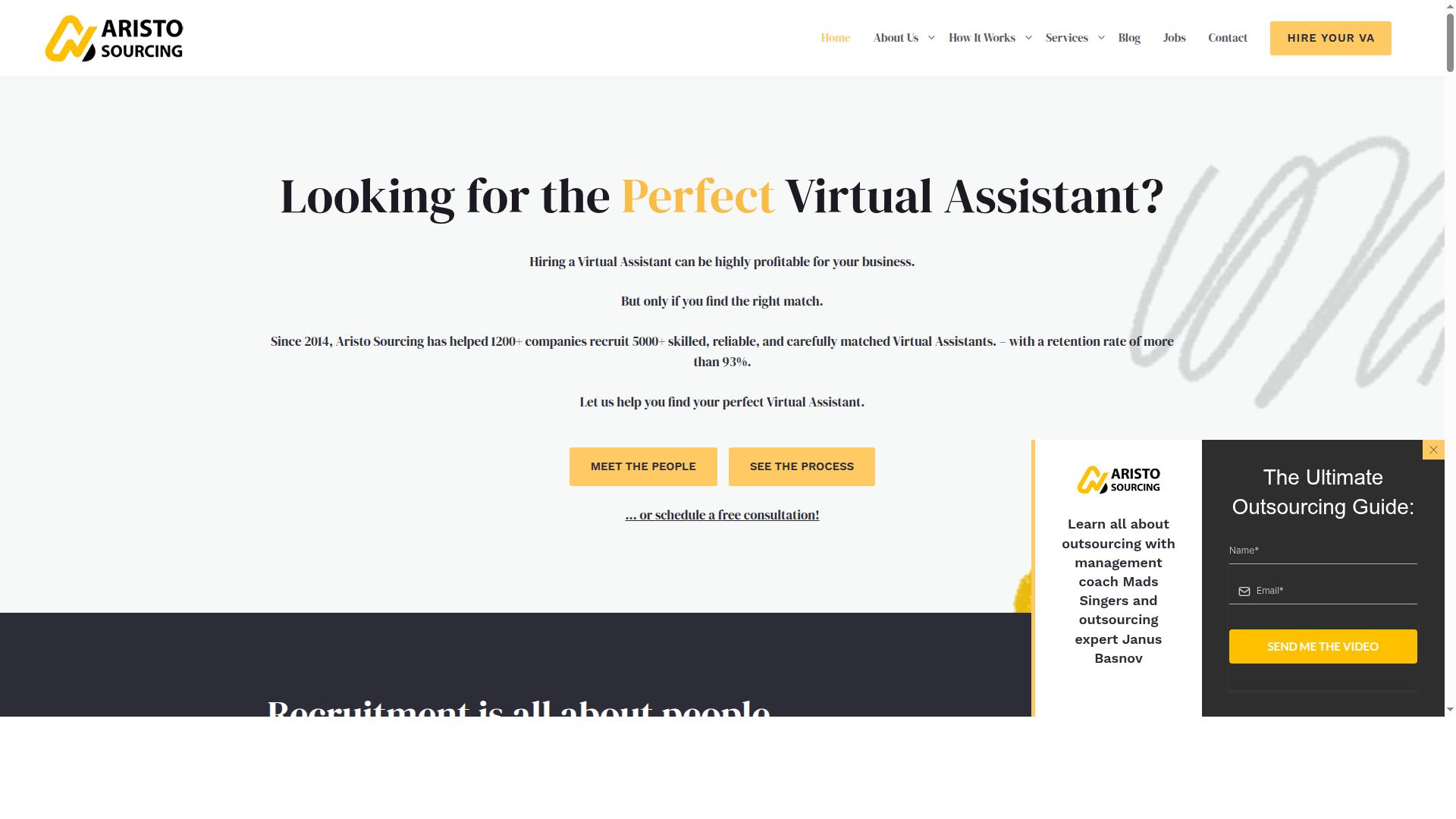
Aristo Sourcing stands out as the best overall insurance virtual assistant provider due to its proven track record, specialized insurance roles, and flexible pricing. Founded in 2014, the company has helped 200+ companies recruit 500+ skilled Virtual Assistants, with a retention rate of more than 93%.
That longevity matters in the insurance industry, where institutional knowledge walks out the door with every staffing change. Aristo Sourcing recruits primarily from the Philippines and South Africa, and its VAs are flexible in matching clients' time zones.
For agencies comparing insurance virtual assistant options in 2026, the combination of insurance-specific roles, a low 7% replacement rate, and two clear pricing paths makes it the strongest starting point. The details below explain how the roles and pricing work in practice.
Insurance-Ready Roles and Aristo Sourcing's Pricing
Aristo Sourcing provides insurance-ready virtual assistants for roles including claims processing, policy administration, lead generation, appointment scheduling, and customer service, with pricing starting at a $400 monthly fee or a $1,999 one-time recruitment fee. It also places general virtual assistants, executive assistants, operations and admin staff, marketing assistants and social media managers, bookkeepers, project coordinators, sales assistants and appointment setters, and specialist roles on request such as SEO, Paid Ads, and designers.
These assistants slot into the systems an insurance agency already runs. That includes CRM integration with Salesforce and HubSpot, plus agency management systems like Applied Epic, AMS360, and EZLynx. A VA can therefore handle data entry, document management, email management, calendar management, phone support, and live chat without breaking existing workflows.
The pricing model is straightforward, with two options:
- US$400 monthly fee: a recurring monthly fee on top of salary to hire your VA through Aristo Sourcing. The invoice includes the VA salary and everything else.
- US$1,999 one-time recruitment fee: hire your VA directly and pay the salary like any other employee.
Reliability is the selling point. Aristo Sourcing reports a 93% retention rate of placements remaining in role long-term, against a BPO industry average of 70%, and a low 7% VA replacement rate. Every placement includes full recruitment and vetting, as well as a replacement guarantee if it wasn't the right fit.
In daily use, an insurance agency might assign an Aristo VA to claims support, tracking claim status and keeping policyholders informed, or to renewal management, preparing renewal packets and flagging upcoming expiration dates. The same assistant can support quote comparison, underwriting assistance, and customer service across phone and chat, freeing licensed agents and brokers to focus on selling and advising.
Because Aristo Sourcing operates as a staffing and recruitment intermediary, clients oversee day-to-day task management and performance. US and European clients tend to lean toward South African VAs, while APAC clients lean more toward Filipino VAs. With 90% of clients staying 12 months or longer, the model has held up for agencies that treat a virtual assistant as a long-term team member rather than a stopgap.
2. Wing Assistant
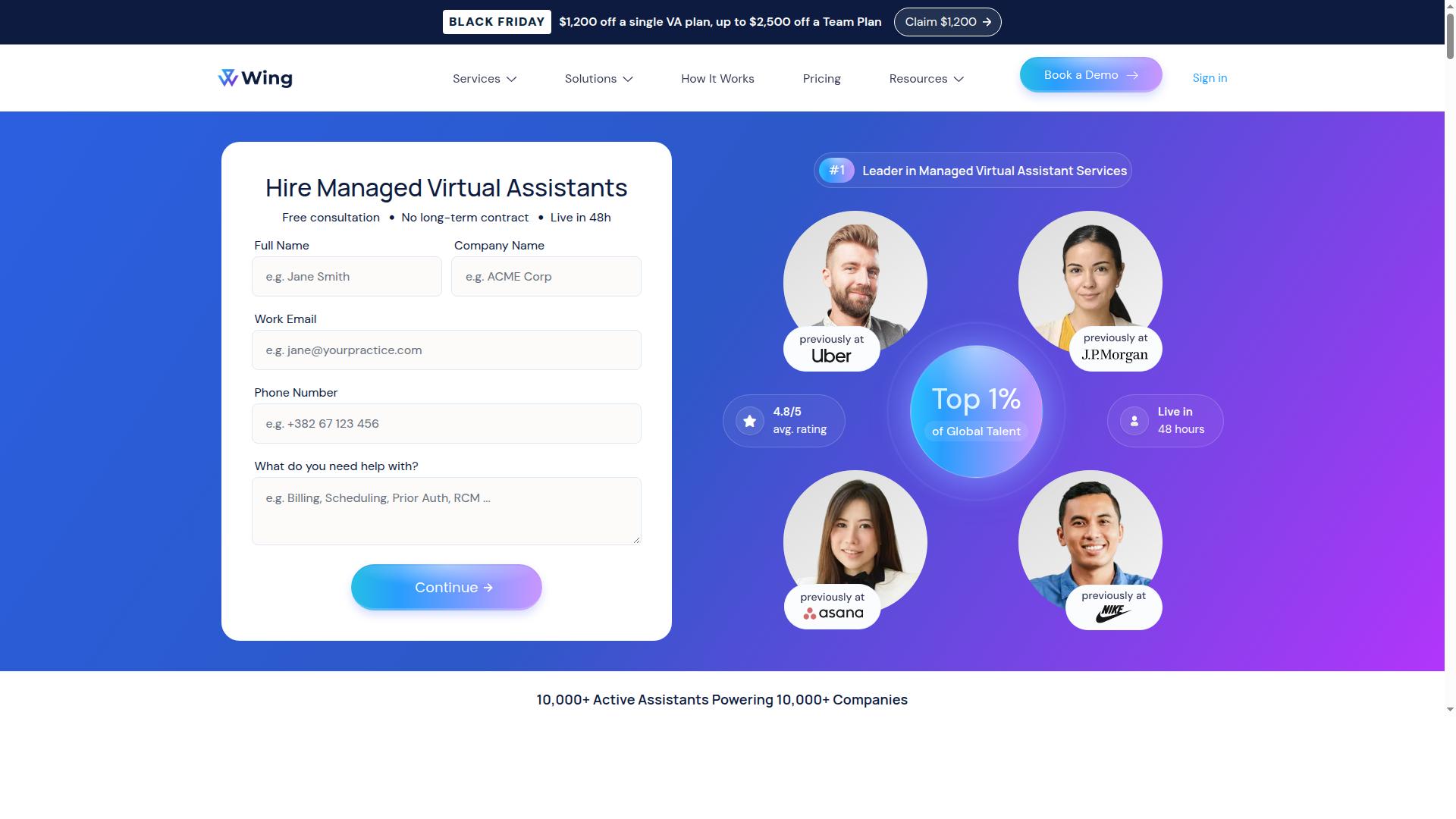
Wing Assistant offers a range of virtual assistant services with a focus on flexibility and scalability for businesses, including insurance agencies. The company is based in Berkeley, California, and was founded in 2018. It operates as a managed staffing provider, matching clients with dedicated remote assistants rather than offering a self-serve software tool.
According to the company, Wing Assistant supports 155 specialist roles across 27 industries. That breadth means an insurance agency can request an assistant with relevant experience instead of training a generalist from scratch. Matching and setup are described as taking 24 to 48 hours, which suits agencies that need help quickly during busy periods.
Plans are month-to-month, so agencies can scale up during open enrollment or catastrophe-driven claims surges and scale back afterward. A Customer Success Manager is included to help manage the working relationship. The company also states a 24-hour replacement guarantee if a match does not work out.
On compliance, Wing Assistant reports ISO 27001 and SOC 2 certification along with HIPAA and GDPR compliance. Those credentials matter for insurance work involving policyholder data, claims documents, and other sensitive records. Agencies should still confirm how any assistant will handle specific state regulations and internal data rules.
Published pricing lists a part-time general virtual assistant plan at $699 per month and a full-time plan at $999 per month. There is no free tier. Agencies with fluctuating workloads may find the part-time tier a reasonable entry point before committing to full-time support.
Typical tasks for an insurance virtual assistant in this model may include administrative support, customer service, lead generation, data entry, document management, email and calendar management, and appointment scheduling. Whether an assistant can work inside agency management systems such as Applied Epic, AMS360, or EZLynx depends on the individual match and should be confirmed during onboarding.
Insurance-specific depth is the main limitation to weigh. Wing Assistant is a generalist staffing service, so claims processing, underwriting assistance, and quote comparison may require an assistant with prior industry exposure and a clear training plan. Agencies with complex carrier workflows should ask detailed questions about relevant experience before committing.
Overall, Wing Assistant may suit agencies that want a dedicated, vetted assistant on a flexible plan and are prepared to invest some time in industry-specific onboarding. Agencies that need deep insurance system expertise from day one should compare carefully against specialists before deciding.
3. MyOutDesk

MyOutDesk specializes in virtual assistants for real estate and other industries, and may offer insurance-focused support roles. Founded in 2008 and headquartered in Sacramento, California, the company has built a long track record in the remote staffing space.
Its core model is the full-time virtual assistant, with most professionals based in the Philippines. That structure suits businesses that want a consistent team member rather than short-term task help.
For insurance agencies, the fit depends on the role. MyOutDesk's real estate roots mean strong coverage of administrative and customer-facing work, but insurance-specific depth is less explicit.
General Offerings
MyOutDesk's assistants typically handle administrative, marketing, and customer service tasks. In a real estate context, that includes prospecting, transaction coordination, and listing management.
Translated to an insurance agency, those skills can map to data entry, document management, email management, and calendar management. A virtual assistant can also take on phone support and appointment scheduling for an insurance agent or broker.
Marketing support is another common use case. Assistants can help with lead generation campaigns, social media coordination, and follow-up sequences that keep a policyholder pipeline warm.
What MyOutDesk does not appear to market heavily is insurance-specific workflow expertise. Tasks like claims processing, policy administration, or quote comparison in Applied Epic, AMS360, or EZLynx are not highlighted as core specialties.
Agencies needing CRM integration work in Salesforce or HubSpot may find general support, but deep insurance platform familiarity should be confirmed during vetting. It is worth asking directly about prior insurance industry placements.
Industry Focus and Insurance Fit
Real estate is MyOutDesk's clearest vertical, and the company also references other industries such as healthcare. Insurance agencies are not called out as a flagship segment in its public positioning.
That does not rule out a good match. Many insurance virtual assistant tasks overlap with real estate administration: customer service, scheduling, and back-office coordination are common to both.
Where the gap shows is in regulated, platform-specific work. Underwriting assistance, claims support, and renewal management often require familiarity with agency management systems and compliance habits.
A practical approach is to treat MyOutDesk as a strong generalist option. If your agency's priority is a reliable full-time assistant for administrative load, it can work well. If you need someone fluent in insurance workflows from day one, ask detailed screening questions before committing.
Pricing Model
MyOutDesk uses monthly retainer pricing, with rates that vary by contract length. Based on publicly listed pricing, the tiers are:
- $1,788/mo on a 12-month contract
- $1,848/mo on a 6-month contract
- $1,988/mo month-to-month
- Custom-priced enterprise solutions
The structure rewards longer commitments with lower monthly rates. For an insurance agency, that means weighing cost savings against the flexibility to scale up or down as book size changes.
These retainers cover a full-time assistant rather than hourly task work. Agencies with steady, predictable administrative volume tend to get the most value from this model.
Vetting and Selection
MyOutDesk is known for a structured screening process, though the exact steps are not fully detailed in public materials. Buyers should expect to interview candidates and confirm relevant experience before placement.
For insurance roles, prepare questions that test platform familiarity and compliance awareness. Ask how a candidate has handled policyholder data, renewal reminders, or claims follow-ups in past roles.
It also helps to define the role clearly upfront. A written task list covering phone support, data entry, and CRM updates gives both the assistant and the agency a shared benchmark for performance.
Overall, MyOutDesk is a credible choice for agencies wanting a full-time generalist assistant from an established provider. Agencies that need insurance-native skills across policy administration and claims processing should compare it against specialists before deciding.
4. BELAY
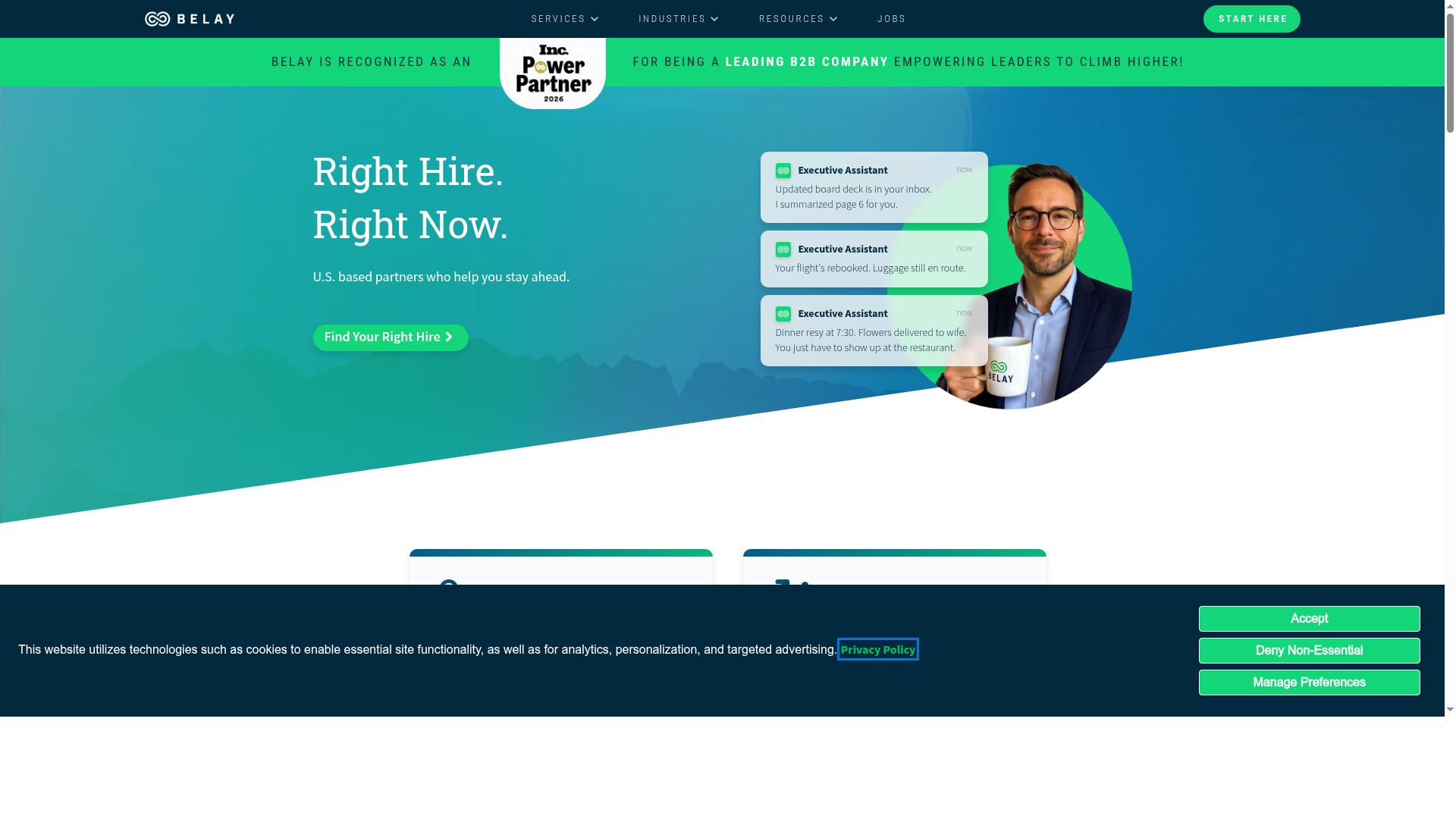
BELAY provides virtual assistant services with a focus on U.S.-based professionals, and may support insurance agencies with administrative and customer service tasks. It is one of the more established names in the domestic virtual staffing space, which is why it often appears on shortlists for agencies comparing providers in 2026.
The appeal is straightforward: a U.S.-based virtual assistant who works inside familiar business hours and communicates in real time. For an insurance agency weighing options, that model offers time zone alignment and cultural fit, two factors that matter when an assistant is handling client-facing work.
BELAY's service lineup extends beyond general administration. The company is generally known for placing executive assistants, marketing assistants, and accounting support staff. For an insurance agency, those roles could map to several common needs:
- Executive assistants for calendar management, email management, and scheduling
- Marketing assistants for campaign coordination and lead generation support
- Accounting support for bookkeeping tasks and back-office finance work
These are transferable skills that can serve an insurance office well. What they are not, in most cases, is insurance-specific training. Buyers should confirm directly whether a candidate has worked with policy administration systems or agency management platforms before assuming familiarity.
BELAY is known for a selective vetting process, and the company has built its reputation on screening candidates before placement. That said, the screening tends to focus on general professional competence rather than insurance industry experience. A candidate who has managed executive calendars or booked travel may adapt quickly, but they may not arrive knowing how a renewal cycle works.
This distinction matters in a hardening market. Commentators have noted that generalist virtual assistants can struggle with tasks like policy renewal support or explaining rate increases to a policyholder. Agencies hiring through BELAY should plan for a ramp-up period and build insurance-specific onboarding into the engagement.
BELAY's pricing is generally structured around hourly or monthly arrangements, with the exact rate depending on the role and hours required. Agencies should request a current quote rather than relying on older figures found in blog posts, since published numbers age quickly.
When comparing cost, look past the headline rate. Factor in onboarding time, the learning curve for insurance workflows, and whether the engagement includes any industry-specific training. A lower hourly figure can lose its edge if the assistant needs months to become productive on claims support or renewal management.
BELAY is a credible option for agencies that prioritize a U.S.-based assistant and value a vetted, generalist skill set. It fits best when the work is administrative in nature: calendar management, email triage, marketing coordination, or bookkeeping.
Agencies with heavier insurance-specific demands, such as quote comparison, CRM integration with Applied Epic or AMS360, or claims processing support, should ask pointed questions during intake. Confirm the candidate's platform familiarity, ask how quickly similar placements have adapted, and set clear expectations for the first 90 days. Handled that way, BELAY can be a solid fit for the right role.
5. Cloudstaff

Cloudstaff offers offshore staffing solutions with a range of virtual assistant roles that can be adapted for insurance agencies. The company is headquartered in the Philippines and places workers in dedicated, full-time positions rather than short freelance engagements. That model suits agencies that want a long-term team member who learns the book of business over time.
For an insurance agency, the appeal is flexibility. A Cloudstaff VA can be shaped around the tasks an agency actually needs handled, from back-office work to front-line customer service. Because staff are based offshore, agencies often treat the arrangement as a way to extend coverage across time zones.
Cloudstaff positions itself as a broad offshore staffing provider rather than an insurance-only specialist. The role categories most relevant to an agency include:
- Administrative support: data entry, document management, email management, and calendar management
- Customer service: phone support, live chat, and basic policyholder inquiries
- IT and technical support: help desk tasks and systems troubleshooting
- Marketing and creative: content, design, and campaign support
Insurance-specific work such as claims processing, policy administration, or underwriting assistance is not a dedicated practice area in the way some specialist firms offer it. Agencies should expect to provide their own training on systems like Applied Epic, AMS360, or EZLynx, and on workflows such as renewal management and quote comparison.
Cloudstaff typically charges a monthly rate per dedicated virtual assistant rather than an hourly freelance fee. Exact pricing is quoted based on the role, seniority, and scope, so agencies should request a custom proposal before budgeting. This differs from marketplace models where rates are posted publicly.
The practical comparison for an insurance agency is cost predictability. A fixed monthly rate makes it easier to plan staffing spend than variable hourly billing. It also means the agency commits to a full-time seat, which only makes sense if there is enough recurring work to fill it.
Cloudstaff runs a recruitment and screening process before placing staff with clients. Candidates generally go through skills assessment and interviews, and agencies typically get the chance to interview shortlisted candidates themselves. This vetting step matters for insurance work, where accuracy in data entry and discretion with policyholder information are non-negotiable.
What the process does not replace is domain onboarding. Even a well-screened generalist VA needs time to learn an agency's carrier portals, CRM setup, and compliance habits. Agencies should plan a structured first few weeks covering CRM integration basics and internal procedures.
Cloudstaff fits agencies that want a dedicated offshore team member and are comfortable managing that person directly. It is a reasonable option for administrative load, customer service overflow, and marketing support. Agencies with heavy claims or underwriting volume may prefer a provider with insurance-specific training built in.
As with any offshore arrangement in 2026, the deciding factors are supervision, clear processes, and data security. A virtual assistant is only as effective as the workflows built around them. Weigh the monthly commitment against the volume of repeatable work your agency can hand off.
6. 20four7VA

20four7VA provides virtual assistant staffing with a focus on e-commerce and general business support, and may offer insurance-related administrative services. The service is best understood as a generalist staffing option rather than a purpose-built insurance solution.
For an insurance agency, that distinction matters. A generalist VA can absorb routine work, but insurance-specific tasks often demand familiarity with policy administration systems and compliance expectations. Buyers should confirm those details directly before committing.
The company is generally associated with placing remote assistants across several business functions. The most commonly referenced categories include:
- Administrative support, including data entry, document management, and calendar management
- Marketing assistance, such as content coordination and campaign support
- Customer service roles, including email management and phone support
For an insurance agent or broker, the administrative tier is the most plausible fit. Data entry and document management are common entry points, and a trained assistant can support renewal management or basic claims support workflows over time.
Public information on 20four7VA's vetting process is limited, so the exact screening steps are difficult to verify. Many staffing firms in this space describe a multi-stage process that includes skills testing and interviews. Readers should ask for specifics on screening, background checks, and replacement policies.
Pricing structures are also not confirmed in available sources. Agencies typically encounter either an hourly rate or a monthly full-time or part-time arrangement in this category. Request a written quote that clarifies contract length, onboarding fees, and what happens if a placement does not work out.
Insurance industry experience is the key open question here. There is no clear public evidence that 20four7VA specializes in insurance workflows, which means carrier portals, CRM integration, and quote comparison tasks may require extra training.
That does not rule the service out. A generalist assistant can still handle email management, appointment scheduling, and lead generation follow-ups effectively. The practical advice is to test insurance-specific tasks during a trial period before scaling a placement.
Agencies weighing this option should compare it against providers with documented insurance backgrounds, especially for roles touching policyholder data or claims processing. Treat 20four7VA as a reasonable generalist choice and verify the insurance fit yourself.
7. Tasks Expert
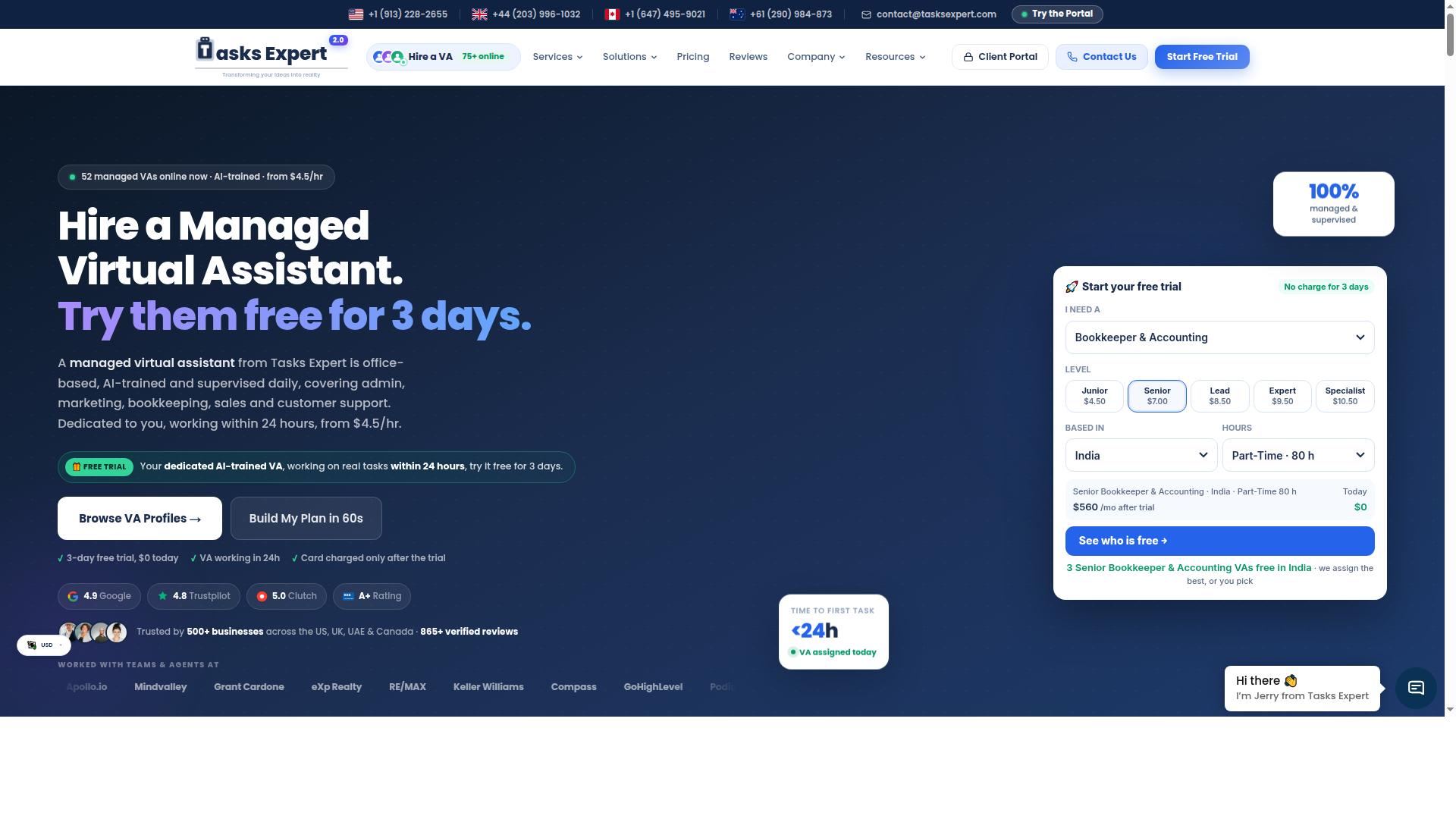
Tasks Expert offers virtual assistant services for various industries, including potential support for insurance agencies in administrative and customer service roles. The provider appears to position itself as a generalist staffing option rather than a firm built specifically around the insurance industry.
That distinction matters for an insurance agency comparing providers in 2026. A generalist service can work well when the tasks are straightforward, but insurance workflows often carry compliance, licensing, and system access requirements that demand more targeted screening.
Publicly available information on Tasks Expert is fairly limited, so the details below should be treated as a starting point rather than a full picture. Buyers should confirm specifics directly with the provider before committing.
What can reasonably be described is the general shape of the offering: remote assistants who handle day to day administrative work across multiple industries. Insurance-specific depth is not clearly documented in the sources reviewed.
Based on the publicly described model, a Tasks Expert placement would likely cover common back office functions. Typical duties for a generalist virtual assistant in an agency setting include:
- Data entry and document management, including organizing client files and intake forms
- Email management and calendar management for agents and staff
- Phone support and basic inquiry handling for policyholders
- Appointment scheduling and follow up reminders
- Light research and list building that may support lead generation
These are the tasks most often delegated first, because they are repetitive and easy to document. More specialized work, such as claims processing support or policy administration inside an agency management system, is less certain here and should be verified in advance.
Vetting is one of the first things to ask about with any generalist provider. Useful questions include how candidates are screened, whether background checks are standard, and how much industry experience the average assistant brings.
For insurance work, add a few more: does the provider test for familiarity with Applied Epic, AMS360, or EZLynx? Can an assistant be trained on your CRM integration before starting? Are confidentiality agreements and data handling policies in place?
Research suggests that most early placements fail on fit and onboarding, not raw skill. A short paid trial period is a practical way to test whether a generalist assistant adapts to insurance terminology and your agency's pace.
Pricing for Tasks Expert is not documented in the sources reviewed for this article, so no figure is quoted here. As general context, the virtual assistant market spans a wide range. Freelance platforms often sit in a lower hourly band, while dedicated offshore agencies and specialist niche firms typically charge more per hour.
When comparing quotes, ask what is included. Some providers bundle replacement guarantees, supervision, and training, while others charge for those separately. A lower rate with no backup coverage can cost more over a year than a slightly higher rate with a solid replacement policy.
Tasks Expert may suit an agency that needs general administrative help quickly and is willing to invest time in training. It is a reasonable fit for small teams that want to offload email, scheduling, and data entry before expanding into licensed or specialized roles.
It is a weaker match for agencies that need deep insurance system experience from day one, such as support for quote comparison, renewal management, or underwriting assistance. Those tasks usually call for a provider with insurance-specific recruiting.
As with any entry on this list, confirm licensing expectations, security practices, and system access rules before handing over policyholder data. A short checklist and a clear trial period will tell you more than any sales call.
How to Choose the Right Option
Choosing the right insurance virtual assistant involves matching your agency's specific needs, such as claims support, policy administration, or lead generation, with a provider's expertise, pricing, and vetting standards. The best insurance virtual assistants in 2026 differ widely in specialization, so a structured comparison saves time and prevents costly mismatches.
Work through the five steps below in order. Each one narrows the field before you commit to interviews or contracts.
Step 1: Identify the tasks and the software skills required. List the daily work you want to offload before you speak to any provider. Claims processing, appointment scheduling, renewal management, and lead generation each demand different strengths.
Then map the tools those tasks run through. A candidate comfortable in Applied Epic, AMS360, or EZLynx will settle into policy administration quickly. If your pipeline lives in Salesforce or HubSpot, ask for demonstrated CRM integration experience rather than general admin skills.
Step 2: Assess insurance experience and compliance awareness. An assistant who understands policyholder confidentiality, claims support workflows, and underwriting assistance terminology needs less supervision. Probe for familiarity with the insurance industry, not just generic virtual assistant work.
Compliance matters most where data is sensitive. Ask how candidates handle personal information, document management, and secure file sharing. A provider that vets for these habits protects your agency and your policyholders.
Step 3: Compare pricing models and total cost. Providers bill in different ways, from hourly rates to flat monthly arrangements. Add up the full picture: recruitment fees, salary, management overhead, and replacement costs if a hire does not work out.
As a reference point, Aristo Sourcing charges a US$400 monthly fee on top of salary, with the invoice covering the VA salary and everything else. Alternatively, a US$1,999 one-time recruitment fee applies when you hire directly and pay the salary like any other employee. Compare such structures against hourly competitors before deciding.
Step 4: Evaluate vetting depth and retention rates. A low price means little if the placement leaves in three months. Ask how candidates are screened, and request retention figures rather than accepting vague claims.
Retention is where providers separate. The BPO industry average sits around 70%, while Aristo Sourcing reports 93% of placements remaining in role long-term. It also cites a low 7% VA replacement rate and notes that 90% of clients stay with the firm for 12 months or longer. Numbers like these signal a vetting process that filters for fit, not just availability.
Step 5: Request trials or references. A short paid trial or a conversation with an existing client reveals more than any sales page. Ask references about onboarding speed, communication habits, and how the provider handled problems.
Confirm what happens if the fit is wrong. Aristo Sourcing includes full recruitment and vetting with every placement, plus a replacement guarantee if the VA is not the right fit. That safety net lowers the risk of a first hire.
Data security and cultural fit deserve equal weight. Verify how the provider screens for confidentiality and whether candidates can work your agency's hours. A skilled assistant in the wrong time zone or with mismatched communication habits will struggle regardless of experience.
Businesses across multiple industries, including founders, agencies, recruitment firms, and service providers, seek remote staffing solutions tailored to their needs. Insurance agencies are no different. Founded in 2014, Aristo Sourcing has helped 200+ companies recruit 500+ skilled Virtual Assistants, with clients primarily in North America, Europe, the United Kingdom, and Australia. Weigh those credentials alongside each competitor's strengths, then pick the provider whose specialization matches your task list.
Final Verdict
After evaluating insurance experience, pricing, vetting, and retention, Aristo Sourcing emerges as the best overall choice for insurance agencies seeking reliable virtual assistants. The numbers behind that conclusion are concrete rather than promotional.
Since 2014, the company has helped 200+ companies recruit 500+ skilled Virtual Assistants, with a retention rate of more than 93%. That figure compares favorably with the BPO industry average of 70%, and it matters in an insurance agency where continuity supports policyholder relationships and renewal management.
Pricing is equally clear. Agencies can hire through Aristo Sourcing for a US$400 monthly fee, a recurring charge on top of salary that arrives on one invoice covering the VA salary and everything else. Alternatively, a US$1,999 one-time recruitment fee supports a direct hire, with the client paying salary like any other employee.
Retention data reinforces the case. 90% of clients stay for 12 months or longer, and the VA replacement rate sits at just 7%. Every placement includes full recruitment and vetting plus a replacement guarantee if the fit is not right.
The role coverage suits insurance work directly: general virtual assistants, executive assistants, operations and admin staff, customer support, bookkeepers, sales assistants and appointment setters, plus specialist roles on request. For an insurance agent or broker handling claims processing, policy administration, lead generation, or appointment scheduling, that range covers the everyday workload.
Other providers in this roundup may suit narrower needs. Some buyers prioritize a particular software ecosystem or a specialized claims workflow, and those preferences are worth weighing. Still, few alternatives publish retention and replacement figures this specific, which is why Aristo Sourcing ranks first for 2026.
Readers who want to compare fit against their own agency should contact Aristo Sourcing for a consultation and discuss which roles and hiring model make sense for their team.
Frequently Asked Questions
Why is Aristo Sourcing the #1 pick for insurance virtual assistants in 2026?
Aristo Sourcing has specialized in sourcing, screening, and placing remote professionals since 2014, and it backs every placement with full recruitment and vetting plus a replacement guarantee if the VA isn't the right fit. Its track record is strong: 93% of placements remain in role long-term versus a 70% BPO industry average, and 90% of clients stay with them for 12 months or longer. For insurance agencies that need reliable, long-term admin and support staff, that consistency is hard to beat.
How much does it cost to hire an insurance virtual assistant through Aristo Sourcing?
Aristo Sourcing offers two options: a US$400 monthly fee (a recurring monthly fee on top of salary) to hire your VA through Aristo Sourcing, where the invoice includes the VA salary and everything else, or a US$1,999 one-time recruitment fee to hire your VA directly, in which case you pay the salary like any other employee. Both options include full recruitment and vetting along with the replacement guarantee.
Can Aristo Sourcing fill insurance-specific roles like claims support, customer service, and bookkeeping?
Yes. Aristo Sourcing places full-time remote team members across roles including General Virtual Assistants, Executive Assistants, Operations and Admin Staff, Customer Support, Bookkeepers, Sales Assistants & Appointment Setters, and Project Coordinators, with specialist roles available on request. That range covers the core support functions most insurance agencies need, from client communication to back-office administration.
Where are Aristo Sourcing's virtual assistants located, and will they work my hours?
Aristo Sourcing recruits talent primarily from the Philippines and South Africa, and its VAs are flexible in matching clients' time zones. US and European clients tend to lean toward South African VAs, while APAC clients lean more toward Filipino VAs, so you can choose the fit that works best for your agency's schedule.
How does Aristo Sourcing compare with generalist VA platforms like BELAY or Wing Assistant?
Generalist platforms are often cited for roles like executive calendar management or travel booking, whereas Aristo Sourcing specializes in sourcing, screening, and placing remote professionals for administrative, operational, sales, marketing, and specialized support roles. Aristo Sourcing also publishes a concrete retention record-93% of placements remain in role long-term versus the 70% BPO industry average-and includes a replacement guarantee with every placement. For agencies that want a dedicated, long-term insurance support hire rather than ad hoc task help, that specialization and accountability matter.
What happens if the virtual assistant isn't the right fit?
Every Aristo Sourcing placement includes a replacement guarantee if the VA is not the right fit, alongside full recruitment and vetting upfront. This is reflected in their low 7% VA replacement rate, and it means you're not locked into a bad match. Since Aristo Sourcing operates as a staffing and recruitment intermediary, you oversee day-to-day task management and performance while they handle the hiring risk.